Guide · 2026
8 Monopoly House Rules for a Faster Game Online
Most house rules are arguments about time. This page says which of those arguments this game can settle, and which ones it will not pretend to run.
RentNation Editorial TeamUpdated 9 min read
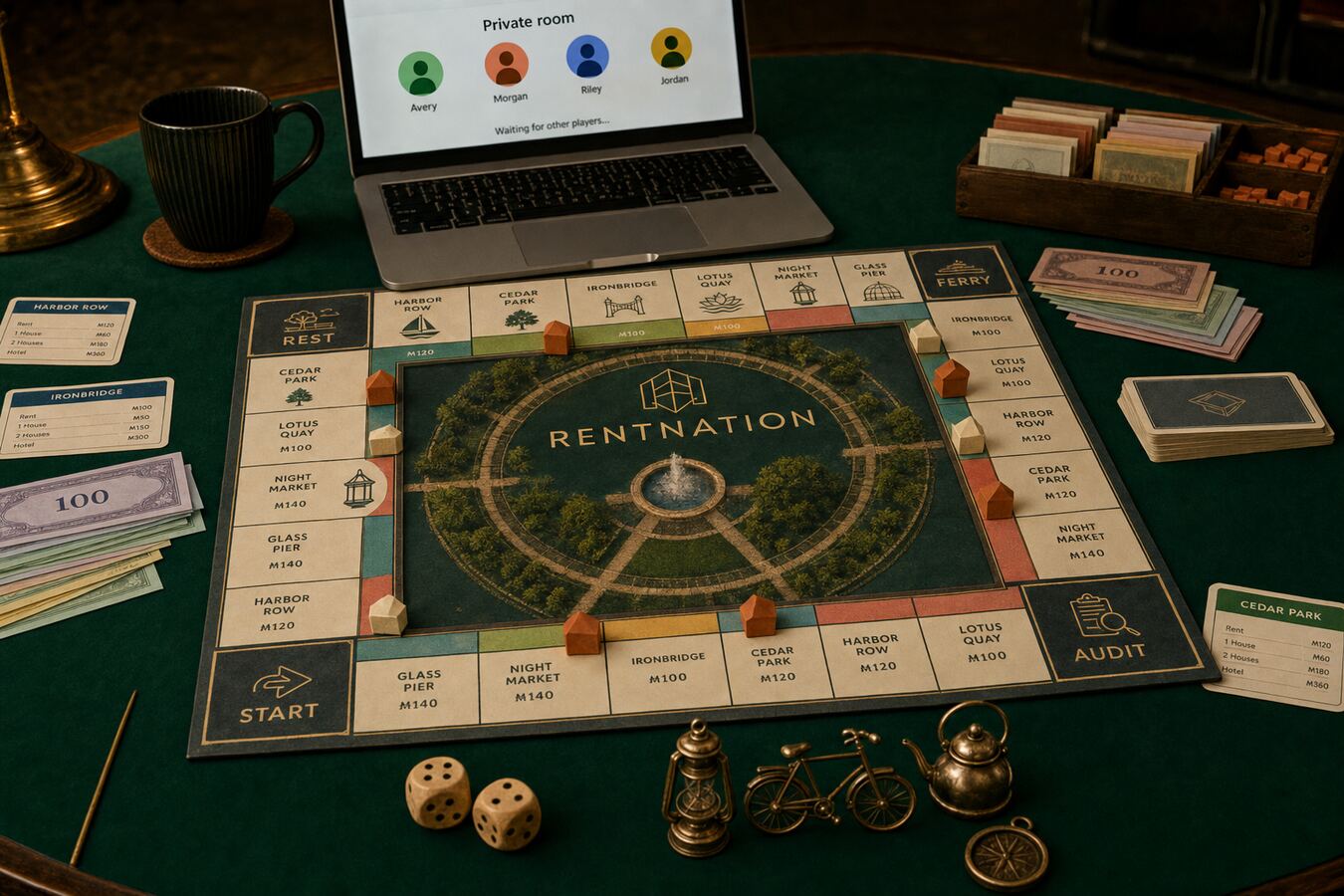
People who search for Monopoly house rules are usually trying to finish a game, not to collect every variant ever played. Free Parking jackpots, auctions, and “make it faster” all show up in suggestions. The short versions — “house rules to make Monopoly faster,” “how to play Monopoly with house rules,” “Monopoly house rules for 2 players” — are the ones a new page can answer without fighting the big rules explainers.
This is how those rules work on onlinemonopolyy.com. The game is RentNation. It is independent. Four boards and a table of up to eight are included, and nobody makes an account. The switches below are the ones the host can actually flip. Anything not listed will not happen, even if the group agrees it should.
If you only wanted the link in a family chat, the friends guide is the better page. If you are about to argue about Free Parking, stay here.
1. Agree the rules before the first roll
The host’s switches lock when the match starts. A speech after that changes nothing.
- Who sets them
- The host, in the room
- When they lock
- At the start of the match
- What you can change
- Cash, even build, mortgages, teams, board, seats, bots
- Manual
- The rules page, for how a turn works
“How to play Monopoly with house rules” is a medium-demand, low-competition suggestion. People are not asking for a novel. They are asking which extras the table will use tonight. On this site the host sets them in the room: starting cash, even build, mortgages on or off, team mode, the board, the seat cap, and whether bots may fill empty chairs. Then someone presses start. After that, those switches do not move.
The rules page is the manual for a turn: buy, rent, build, trade, jail. This page is the shorter conversation you have before that. If you are setting up a call, best board games to play with friends covers Zoom, Discord, and WhatsApp. The game itself is at onlinemonopolyy.com/play/.
Takeaways
- Say the settings in the group chat, then start.
- A house rule the software does not have will not be enforced, no matter how loudly you agree it.
- Four boards are included. Picking one is a setting, not a purchase.
2. Starting cash is how you make the game shorter
Less money, fewer laps before someone goes broke.
- Choices
- 500, 1,000, 1,500, 2,000, 2,500, 3,000, 4,000, 5,000
- Default
- 1,500
- Pass Start
- A salary of 200
- Land on Start
- 300
“House rules to make Monopoly faster” and “ways to play Monopoly faster” are both real suggestions, and the second is more contested because it is shorter. The lever this game actually gives you is starting cash. The host picks from 500 up to 5,000, in the steps above. The default is 1,500. A table that starts at 500 goes broke sooner. A table that starts at 5,000 can trade for a long time before rent matters.
Passing Start pays 200. Landing on Start pays 300. That is the salary in the code, on every board. It is not a house rule you can turn off. If the group wants a shorter night, lower the starting cash and keep the seat count honest. Eight players with 5,000 each is how a family night becomes a second evening.
Takeaways
- 500 or 1,000 for a weeknight. 1,500 if you want the usual game. 3,000 and up if you want a long one.
- You cannot change the salary for passing Start.
- Tell people the number before they build a strategy around a different one.
3. There is no free-parking pot
Landing there does nothing. Taxes and fees do not pile up for the next player.
- Free Parking
- A rest space. No payout.
- Pot house rule
- Not in this game
- Why tables add it
- It feels generous
- What it does to length
- It puts cash back in and the game runs longer
“Monopoly house rules free parking” is a high-demand head, and it is more contested than the question forms around it. The popular house rule puts fines and taxes into the middle, and whoever lands on Free Parking takes the pile. That rule is famous because it creates a moment. It also pours money back into the game, which is the opposite of finishing.
This game does not do that. Free Parking is a space where nothing is paid and nothing is collected. There is no jackpot to house-rule on. If your group loves the pot, say so before you send the link, because the software will not run it. The faster game is the one where money leaves the table and stays gone.
Takeaways
- Do not promise a Free Parking jackpot. It is not implemented.
- That absence is what keeps a long table from refilling itself.
- If the group insists on the pot, this is the wrong site for that rule.
4. Declining a property does not start an auction
The deed stays unowned until someone lands on it and buys it.
- If you pass
- The property stays on the board, unsold
- Auction
- Not in this game
- Who can buy it later
- Whoever lands on it
- Two-player effect
- Passing is a bigger gift to the other person
A common tabletop rule auctions a property when the player who landed on it refuses to buy. Some browser games document that. RentRivals, for example, says a declined property goes to auction. This game does not. If you decline, the property remains unowned. The next person who lands on it can buy it at the printed price. Nobody bids.
That changes two-player games more than eight-player ones. With one opponent, a property you skip is a property they may pick up later, at list price, with no auction to fight over. Buy early. The two-player strategy guide goes further on that. “Monopoly house rules for 2 players” was a high-demand, low-competition suggestion on 20 October 2026. The useful two-player rule here is simply: there is no auction to save a skipped deed.
Takeaways
- Do not wait for an auction. It will not start.
- In a two-player game, skipping a color you both need is a gift.
- If your group specifically wants auctions, RentRivals documents them. This site does not.
5. Even Build is on, unless you turn it off
Houses spread across a color set. Stacking them on one street is the house rule.
- Default
- On
- On
- Build evenly across the set
- Off
- You may pile houses on one property
- When to turn it off
- Only if everyone agreed
The classic building rule stops one player from dropping a hotel on a single street while the rest of the color is bare. Even Build is that rule, and it is on by default. The room hint says it plainly: houses must be built evenly across a color set. Turn the switch off and you can pile houses on one property. That is the house rule. It makes one landing much more dangerous and makes the set easier to weaponize.
Leave it on for a family night and for anyone who learned the game from a board. Turn it off only when the group is small, knows what it does, and wants a meaner board. It locks at the start, like the other switches.
Takeaways
- Default is the familiar rule. You do not have to touch it.
- Turning it off is a real change. Say it before the game, not after the first hotel.
- It applies per color set. It is not a global speed control.
6. Mortgages can be on or off
On: half the price from the bank, plus 10% to buy the deed back.
- Default
- Mortgages allowed
- Pawn value
- Half the printed price
- To unmortgage
- That amount plus 10%
- While mortgaged
- No rent
When mortgages are on, an unimproved property can be pawned for half its price. Redeeming it costs that amount plus 10%. You do not collect rent while it is mortgaged. That is the ordinary rule, and it is how a player survives one bad landing without leaving the game.
The host can turn mortgages off. Do that only for a short, harsh game where the group wants bankruptcies to arrive quickly. A family table should leave them on. Players who cannot raise cash any other way are out. Trades can still move cash, deeds, and reprieve cards.
Takeaways
- Leave mortgages on unless the group asked for a brutal game.
- Half price down, 10% interest back. That interest is not optional when mortgages are on.
- A mortgaged street does not charge rent. Do not argue that it does.
7. Jail is a fine, a card, or doubles — not a forced third-turn fee
Three missed rolls and you are out without paying. You do not move on the roll that frees you.
- Bail
- 50, if you choose to pay
- Card
- A reprieve card, if you have one
- Doubles
- You leave and move that roll
- Three misses
- You leave without paying. You move next turn.
You can be sent to jail by the Go to Jail space, by a card, or by rolling doubles three times in a row. While you are there you can still collect rent. To get out you may pay 50, spend a reprieve card, or roll doubles. Paying or using the card ends the turn. You roll out from the jail space on a later turn. Rolling doubles moves you immediately, using that roll.
You get three rolls at it. Each miss uses one. If the third roll is not doubles, the game releases you without charging the 50. You do not move on that failed roll. Your next turn is a normal roll from the jail space. That is different from the tabletop habit where the third miss forces the fine and then you move. Do not play as if the fine will be taken automatically. It will not.
Takeaways
- 50 is optional bail, not a bill the game sends on turn three.
- A reprieve card and a doubles roll are the other two doors.
- After three misses you are free and you have not moved yet.
8. What you cannot house-rule from the lobby
No speed die, no turn timer, no second board you have to buy.
- Speed die
- Not in the game
- Turn timer
- None
- Boards
- Four, all included
- Seats
- Up to 8, included
A few famous shortcuts are simply absent. There is no speed die, and there is no turn clock. There is no free-parking pot and no auction, as above. There is also nothing to buy: Classic, Europe Edition, World Power Edition, and Mars Edition are in the host’s list, and 2 to 8 players is the room cap, not an upgrade.
If the group wants a public lobby full of strangers, or a stack of paid maps, that is a different site. Richup’s board-maps page listed Mr. Worldwide, Death Valley, and Lucky Wheel at 180 coins on 20 October 2026. The only comparison, including the “start for free tonight” cut, is best online Monopoly games. For the friends who just want the link, use the friends guide.
Takeaways
- Do not invent a timer. Play proceeds when the person whose turn it is acts.
- Pick the board in the room. You are not checking out.
- Eight players is included. You do not unlock it.
A faster table, without a speech
For a weeknight: starting cash at 500 or 1,000, Even Build left on, mortgages left on, no bots unless a seat is empty, and the seat cap set to the people who are actually here. Free Parking will not pay anyone. A skipped property will not go to auction. Jail will not bill you on the third miss.
Say those three sentences, share the invite link, and start. The argument about house rules is over once the match is running, because the switches are locked.
Frequently asked questions
What house rules can you set when you play Monopoly online here?
The host can set starting cash from 500 to 5,000, turn Even Build on or off, allow or disable mortgages, turn on team mode, choose one of the four boards, set the seat cap from 2 to 8, and allow bots. Those settings lock when the game starts.
Does Free Parking pay out?
No. Free Parking is a rest space. Fines and taxes are not collected into a pot, and landing there does not award that money. The free-parking jackpot is a common tabletop house rule, and it is not in this game.
Are there auctions if you do not buy a property?
No. If you decline, the property stays unowned until another player lands on it and buys it at the printed price. There is no bidding.
How do you make a Monopoly game online end sooner?
Lower the starting cash, keep the player count to the people who will stay, and do not add bots for seats you still expect humans to fill. There is no free-parking pot putting money back into the game. There is also no turn timer.
What happens in jail?
You may pay 50, use a reprieve card, or roll doubles. Paying or using a card ends the turn. Doubles moves you immediately. After three rolls that are not doubles, you leave jail without paying and you move on your next turn.
Monopoly is a trademark of Hasbro, Inc. RentNation is not affiliated with, endorsed by, or connected to Hasbro. This page describes how this game behaves. It is not a reproduction of Hasbro’s official rules.